
How CloudMyle Delivers Websites, Apps & Cloud Systems: Our 6-Stage Framework
In short
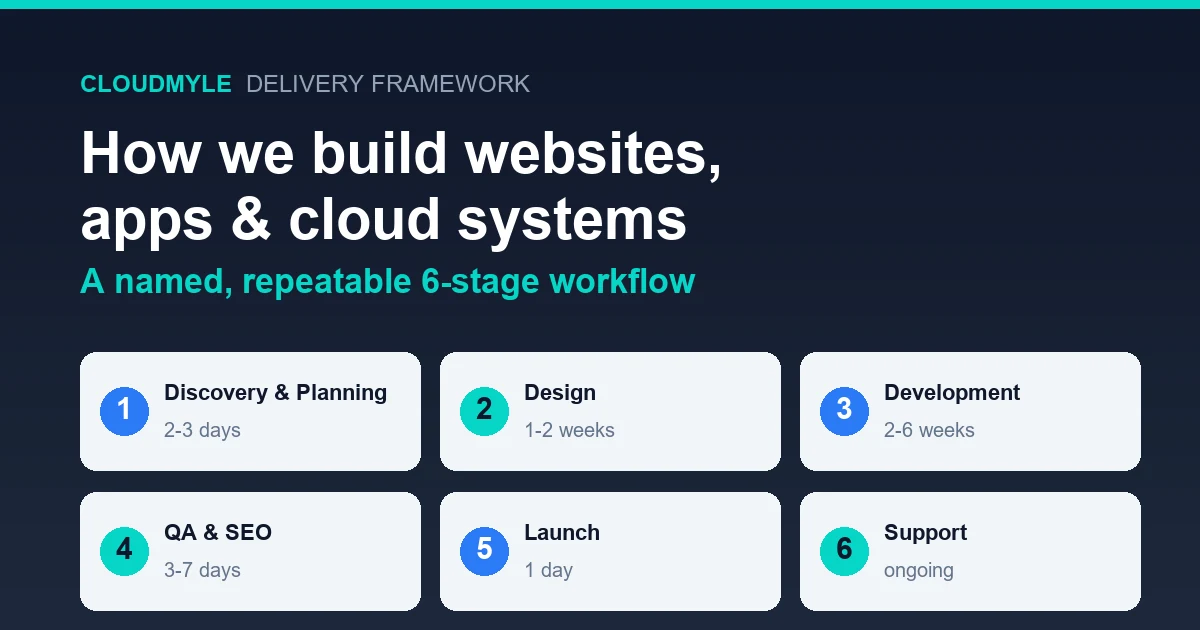
CloudMyle ships websites, apps and cloud systems through one named, repeatable workflow: six stages — Discovery, Design, Development, QA & SEO, Launch and Support — with weekly demos, a single point of contact, and 90 days of free support after launch. The same framework runs on every project, so you always know where yours stands.
CloudMyle is a web and app development company based in the Financial District, Hyderabad, serving clients across India, the UAE, the UK and the US. We have delivered 450+ projects since 2023 with a 98% client-satisfaction rate. This page explains exactly how we work — the same framework we use on every engagement.
Most agencies describe their process in three vague words: discovery, build, support. That tells you nothing about what actually happens between a signed contract and a product that earns money, and it gives you no way to hold anyone accountable when a week goes quiet. So we wrote the whole thing down and put timelines on it. The CloudMyle Delivery Framework is the named, repeatable workflow behind every one of our 450+ projects, and it is built on one principle: ship in slices, show progress every week, and never disappear after launch.
Why a named framework matters
When a project fails, it rarely fails during coding. It fails in the gaps — unclear scope, silent weeks, a launch with no SEO, a handover with no support. A framework closes those gaps by making every stage visible and every deadline owned. It is also why our average project kicks off within two weeks and 97% of our work ships on time. You are not buying hope; you are buying a process you can watch.
The framework is deliberately boring in the best sense: it is the same on a ₹30,000 business website as it is on an ₹8,00,000 custom platform. The scope changes, the stack sometimes changes, but the stages, the weekly rhythm and the single point of contact do not. That consistency is what lets a first-time founder and an enterprise product owner both know, on any given Friday, exactly where their project stands.
The six stages, start to finish
Stage 1 — Discovery & Planning (2–3 days)
We map goals, users, scope and success metrics before anyone writes code. You leave discovery with a fixed feature list, a timeline, and a single point of contact who stays with you to launch. Our median response time during a project is under 30 minutes, so questions never sit for days. This stage exists to make the rest of the project predictable: when scope is agreed in writing up front, there are no surprise invoices and no "that wasn't what we meant" conversations three weeks in.
Stage 2 — Design (1–2 weeks)
We design mobile-first wireframes and a clickable UI, then review them with you in a live demo. Nothing moves to development until you approve the screens. This is where most costly rework is prevented — changing a layout is cheap, changing shipped code is not.
Stage 3 — Development (2–6 weeks)
We build in slices. Instead of vanishing for a month, we deliver working pieces of the product and show them in weekly demos, so you always know what exists and what is next. Our stack — React, Next.js, Node.js, Flutter and AWS — is chosen for speed and long-term maintainability, not novelty.
Stage 4 — QA & SEO (3–7 days)
Every build is tested across devices and tuned for Core Web Vitals, accessibility and on-page SEO before it goes live — performance and search readiness are optimised on every build. Search readiness is part of delivery here, not a paid add-on you discover later.
Stage 5 — Launch (1 day)
We handle deployment, DNS, SSL, analytics and search-console setup in a single coordinated go-live, with a rollback plan ready. You get a clean handover: credentials, documentation and a walkthrough.
Stage 6 — Support (ongoing)
Every project includes 90 days of free post-launch support. After that, maintenance retainers start at ₹8,000/month and SEO retainers at ₹15,000/month. A partner after launch is the whole point — not an upsell.
Mini case study: ORN Gateway
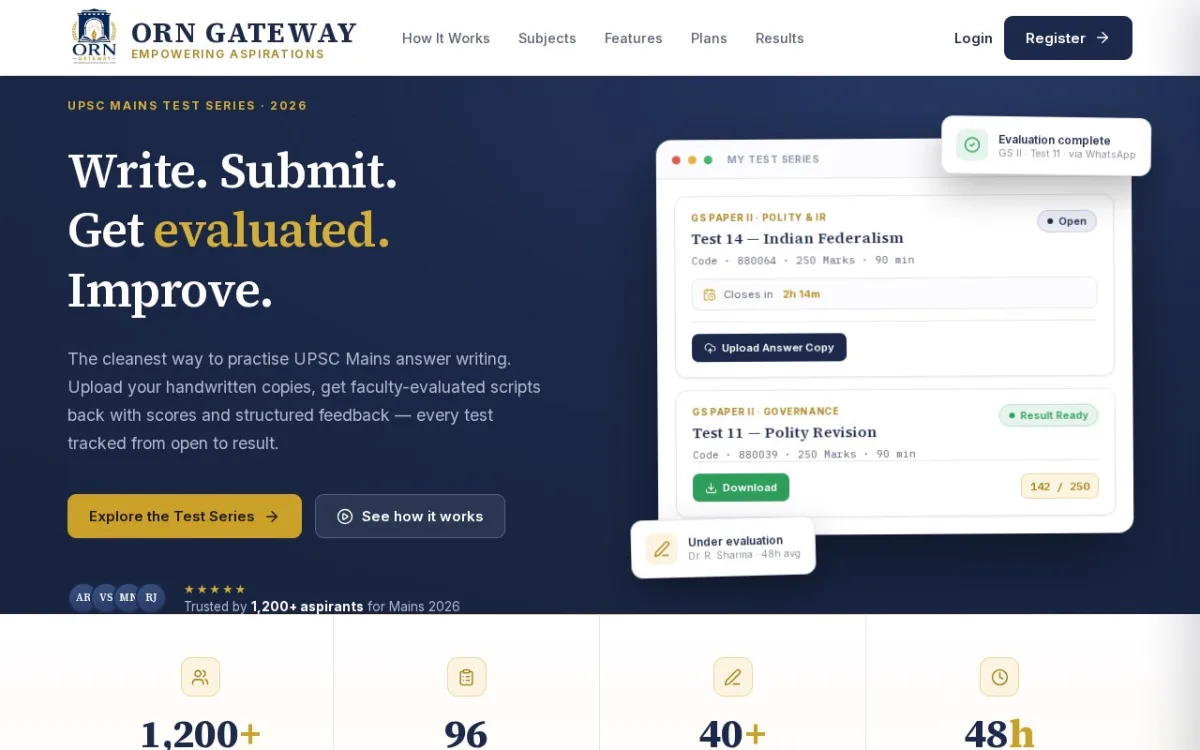
The brief. ORN Gateway, an EdTech platform, needed a UPSC answer-evaluation system that could handle serious volume without slowing down the human examiners who grade each submission.
How the framework handled it. In Discovery we mapped the full aspirant-to-evaluator journey and set one hard target: a 48-hour evaluation turnaround at scale. Design produced a submission-and-feedback flow examiners could move through quickly. During Development, weekly demos let the ORN team adjust the evaluation workflow while it was still cheap to change. QA & SEO hardened the platform for load, and Launch went live in a single day.
The result. The platform now supports 1,200+ aspirants and holds a 48-hour evaluation turnaround — a measurable outcome, not a vague promise. Because QA and SEO were part of delivery rather than an afterthought, the platform launched stable under real exam-season load instead of buckling the week it mattered most. It is a clear example of what "ship in slices, support after launch" looks like in practice. Read the full ORN Gateway case study.
The same pattern shows up across sectors. For MC Logistics, a freight and logistics client, the framework produced a platform now tracking 5,000+ consignments; for RupayBill, it delivered a GST billing and payments app in the fintech space. Different industries, the same six stages — which is exactly the point of naming the workflow instead of improvising one each time.
Why you can trust these numbers
Credibility is not a tone of voice; it is something you can check. Every figure on this page is one we report publicly and stand behind: 450+ projects delivered since 2023, a 98% satisfaction rate, 97% on-time delivery, and a 5.0-star rating from 40 verified reviews on our Google Business Profile. Our work is listed by name — SaveMyPlate, Kshetra Online, Tulja Bhavani Projects, ORN Gateway and others — so you can look at real projects rather than stock mock-ups. If a claim here matters to your decision, ask us for the detail behind it, and a single point of contact will walk you through it within 30 minutes.
Frequently asked questions
How long does a project take with CloudMyle?
Most projects kick off within two weeks and ship on a 4–10 week timeline depending on scope. A simple business website moves faster; a custom web or mobile app sits at the longer end. 97% of our projects are delivered on time.
Is SEO included or extra?
On-page SEO and performance tuning are built into Stage 4 of every project at no extra cost. Ongoing SEO growth retainers are optional and start at ₹15,000/month.
What happens after launch?
Every project includes 90 days of free post-launch support. After that you can move to a maintenance retainer from ₹8,000/month.
Where is CloudMyle based and who do you work with?
We are based in the Financial District, Hyderabad, and work with startups, SMEs and D2C brands across India, the UAE, the UK and the US, in sectors including fintech, EdTech, logistics, real estate, agriculture and e-commerce.
Ready to see this framework applied to your project?
Start your project and get a response in under 30 minutes.